
The Ultimate Guide to Selecting the Right Handgun in Colorado
November 3, 2026 · Shooting Education / Firearm Guides / Handgun Selection
Introduction
Selecting the right handgun is one of the most critical decisions any firearm enthusiast, self-defense advocate, or sport shooter will make. Whether you're a complete beginner stepping into the world of firearms for the first time or an experienced shooter looking to add another reliable tool to your collection, understanding how to select the right handgun Colorado residents can depend on requires careful consideration of multiple factors.
The handgun market offers an overwhelming array of options, from compact concealed carry pistols to full-size competition firearms, each designed with specific purposes and user preferences in mind. Modern handguns serve various roles including personal protection, competitive shooting, hunting, and recreational target practice. Each application demands different characteristics in terms of size, weight, caliber, and functionality.
This comprehensive guide will walk you through every essential aspect of handgun selection, from understanding fundamental differences between firearm types to evaluating your personal needs and physical requirements. We'll explore the legal landscape specific to Colorado, discuss the importance of proper training, and provide practical advice for making an informed decision that aligns with your goals and circumstances.
By the end of this guide, you'll have the knowledge and confidence to approach handgun selection systematically, ensuring your choice serves you well for years to come while maintaining the highest standards of safety and responsibility.
Understanding Handgun Types
When learning how to select the right handgun Colorado shooters must first understand the fundamental differences between the two primary categories: revolvers and semi-automatic pistols. Each type offers distinct advantages and considerations that directly impact their suitability for different applications and user preferences.
Revolvers feature a rotating cylinder that holds ammunition in individual chambers, typically ranging from five to eight rounds. These firearms are renowned for their mechanical simplicity and reliability, making them excellent choices for beginners who want straightforward operation. Revolvers require minimal maintenance, rarely experience feeding issues, and offer consistent trigger pulls. However, they generally hold fewer rounds than semi-automatics and require more time to reload. Double-action revolvers can be fired by simply pulling the trigger, while single-action models require manual cocking of the hammer.
Semi-automatic pistols use the energy from fired cartridges to cycle the action, automatically ejecting spent cases and loading fresh rounds from a detachable magazine. These firearms typically offer higher ammunition capacity, faster reloading capabilities, and more compact profiles for concealed carry. Modern semi-automatics incorporate various safety systems and often feature accessory rails for lights or lasers. However, they require more maintenance and can be more sensitive to ammunition quality and proper grip technique.
Caliber considerations play a crucial role in handgun selection. The .22 Long Rifle offers minimal recoil and affordable ammunition, making it ideal for training and small game hunting. The 9mm Parabellum provides an excellent balance of manageable recoil, adequate stopping power, and high capacity, explaining its popularity among law enforcement and civilian users. The .40 Smith & Wesson delivers increased stopping power with moderate recoil, while the .45 ACP offers substantial knockdown power with heavier bullets but reduced capacity and increased recoil.
Specialty handguns serve specific purposes within the shooting community. Self-defense handguns prioritize reliability, quick deployment, and adequate stopping power in compact packages. Competition firearms emphasize accuracy, consistent triggers, and ergonomic designs that enhance performance. Hunting handguns typically feature longer barrels, powerful calibers, and robust construction to handle demanding field conditions.
How to Assess Your Needs
Before exploring specific handgun models, you must honestly evaluate your intended use, experience level, and personal circumstances. This assessment forms the foundation for making an informed decision about how to select the right handgun Colorado law permits you to own and operate safely.
Determining your primary purpose significantly influences every subsequent decision in the selection process. Self-defense applications typically favor compact, lightweight handguns that can be easily concealed and quickly deployed. These firearms prioritize reliability over precision, featuring simple controls and proven stopping power. Sport shooting encompasses various disciplines, each with specific requirements. Target shooting emphasizes accuracy and consistency, often favoring full-size handguns with excellent triggers and adjustable sights. Competitive shooting may require specialized features like extended magazines, custom triggers, or specific calibers mandated by competition rules.
Hunting applications demand handguns capable of delivering adequate energy at extended ranges, typically featuring longer barrels, powerful calibers, and robust construction. Some hunters prefer handguns for their portability and challenge, while others use them as backup weapons during rifle hunts. Consider whether you'll primarily hunt small game, which might require only a .22 caliber, or larger game that demands more powerful cartridges.
Experience level assessment helps determine appropriate complexity and features. Complete beginners benefit from simple, reliable designs with minimal controls and forgiving operating characteristics. Revolvers often suit new shooters because they eliminate concerns about proper grip technique, ammunition sensitivity, or complex safety systems. Intermediate shooters might appreciate semi-automatics with standard safety features and moderate capacity, while advanced users can handle specialized firearms with custom triggers, multiple safety systems, or competition-specific features.
Physical attributes directly impact handgun suitability and shooting performance. Hand size determines appropriate grip dimensions and trigger reach. Individuals with smaller hands may struggle with large-frame handguns, while those with larger hands might find compact firearms uncomfortable or difficult to control. Strength considerations affect your ability to manage recoil and operate various controls. Age-related factors like arthritis might make certain trigger types or slide manipulations challenging. Visual considerations include your ability to align various sight types and whether you require prescription shooting glasses or corrective lenses.
Key Features to Consider
Understanding critical handgun features enables you to evaluate specific models systematically and identify characteristics that align with your needs and preferences. These features directly impact comfort, accuracy, safety, and overall shooting experience.
Grip size and texture fundamentally influence your ability to control the handgun effectively. The grip should allow you to reach the trigger comfortably with the pad of your index finger while maintaining a secure hold with your remaining fingers. Grips that are too large cause difficulty reaching the trigger and reduce control, while grips that are too small may allow the handgun to shift during recoil. Modern handguns often feature interchangeable grip panels or backstraps to accommodate different hand sizes.
Grip texture affects your ability to maintain consistent hand placement and control during rapid fire or adverse conditions. Aggressive texturing provides superior grip but may be uncomfortable during extended shooting sessions or cause clothing wear during concealed carry. Smooth grips feel comfortable but may become slippery when wet or during stressful situations. Many manufacturers offer moderate texturing that balances comfort with functionality.
Weight and balance characteristics significantly impact shooting performance and carry comfort. Heavier handguns generally produce less felt recoil and provide more stable shooting platforms, enhancing accuracy for target shooting or competition. However, increased weight becomes problematic for concealed carry or extended shooting sessions. Lighter handguns offer superior portability but may generate more felt recoil and muzzle flip, potentially affecting accuracy and follow-up shot speed.
Balance refers to how weight is distributed throughout the handgun. Muzzle-heavy designs help reduce felt recoil and muzzle rise but may feel unwieldy for some users. Grip-heavy handguns point naturally but may generate more muzzle flip. Well-balanced handguns feel neutral in your hand and typically offer the best compromise for general use.
Sights and sighting options determine your ability to aim accurately under various conditions. Basic iron sights consist of a front post and rear notch that must be aligned with your target. Three-dot systems use white or colored dots to enhance sight alignment, while tritium night sights provide visibility in low-light conditions. Fiber optic sights gather ambient light to create bright aiming points that work well in daylight conditions.
Many modern handguns accommodate red dot sights, which project an illuminated reticle onto a small window mounted above the slide. These sights enable faster target acquisition and improved accuracy, particularly for shooters with aging eyesight. However, they require batteries and add complexity to the system.
Safety features vary significantly between handgun types and manufacturers. Manual safeties require deliberate manipulation to fire the handgun, providing an additional layer of protection but adding complexity to the firing sequence. Trigger safeties prevent firing unless the trigger is pulled properly, while drop safeties prevent discharge if the handgun is dropped or struck.
Trying Before You Buy
Hands-on experience with potential handgun choices provides invaluable insights that specifications and reviews cannot convey. Physical interaction reveals comfort, controllability, and suitability factors that directly influence your shooting performance and satisfaction with your eventual purchase.
Importance of hands-on experience cannot be overstated when selecting a handgun. Every individual has unique physical characteristics, preferences, and needs that affect handgun suitability. What works perfectly for one shooter may be completely inappropriate for another, regardless of reviews or recommendations. Handling different handguns allows you to assess grip fit, trigger reach, sight alignment, and overall ergonomics before making a financial commitment.
Many features that seem appealing in theory may prove problematic in practice. A handgun that feels comfortable during brief handling might become uncomfortable during extended shooting sessions. Controls that appear well-positioned might be difficult to manipulate under stress or while wearing gloves. Sights that look adequate in good lighting might prove inadequate in challenging conditions.
Choosing the right firearm fit involves systematic evaluation of multiple factors during hands-on testing. Begin by ensuring you can grip the handgun securely with your shooting hand while reaching the trigger comfortably with your index finger. The trigger should contact the pad of your finger, not the joint or tip. Your thumb should rest naturally without interfering with controls or creating an awkward grip angle.
Evaluate sight alignment by bringing the handgun to your natural shooting position and checking whether the sights align easily with your dominant eye. Some handguns may require you to tilt your head or adjust your grip to achieve proper sight picture, which can affect accuracy and consistency. Test various controls including the magazine release, slide stop, and any safety mechanisms to ensure you can operate them reliably without shifting your grip significantly.
Consider how the handgun feels during simulated shooting scenarios. Practice drawing from a holster if possible, and evaluate how quickly you can acquire a proper grip and sight picture. Some ranges offer training scenarios that allow you to test handguns under more realistic conditions than simple bench shooting.
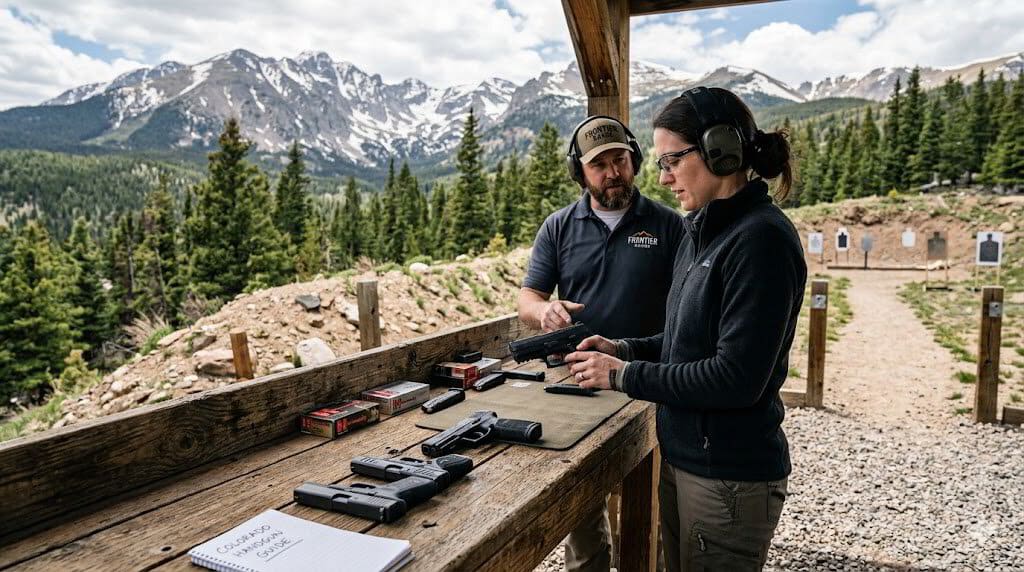
Local ranges that offer handgun rentals provide excellent opportunities to test multiple firearms before making a purchase decision. Most rental programs include basic instruction and safety briefings, making them suitable for beginners who want to experience different handgun types safely. Rental fees typically include the firearm, basic safety equipment, and range time, though ammunition is usually purchased separately.
When visiting rental ranges, come prepared with specific questions about the handguns you're considering. Experienced range staff can provide valuable insights about reliability, maintenance requirements, and suitability for your intended applications. Many ranges also offer training courses that incorporate various handgun types, allowing you to receive professional instruction while testing different options.
Legal Considerations in Colorado
Understanding Colorado's firearm laws ensures your handgun selection and ownership comply with state and federal regulations. Legal compliance protects you from criminal liability while ensuring you can legally possess and use your chosen handgun for its intended purposes.
Understanding Colorado gun laws begins with recognizing that the state generally follows federal firearms regulations while adding specific state requirements. Colorado requires background checks for all handgun transfers, including private sales and gun shows, with limited exceptions for immediate family members and temporary transfers. The state prohibits certain individuals from possessing firearms, including convicted felons, individuals subject to restraining orders, and those with specific mental health disqualifications.
Colorado law establishes eighteen as the minimum age for handgun possession, though federal law requires purchasers to be twenty-one to buy handguns from licensed dealers. The state allows constitutional carry for individuals twenty-one and older who are legally eligible to possess firearms, meaning concealed carry is permitted without a permit. However, obtaining a concealed handgun permit provides additional benefits including reciprocity with other states and exemption from certain restrictions.
Magazine capacity restrictions limit new purchases to fifteen rounds for handguns, though magazines owned before the law's effective date remain legal. This restriction affects handgun selection for some users who prefer higher-capacity firearms. Certain locations prohibit firearm possession regardless of permit status, including federal buildings, schools, and some local government facilities.
Requirements for concealed carry permits in Colorado involve meeting specific eligibility criteria and completing required training. Applicants must be Colorado residents or military members stationed in the state, at least twenty-one years old, and legally eligible to possess firearms. The application process includes fingerprinting, background checks, and payment of required fees.
Training requirements mandate completion of an approved firearms safety course that covers firearm safety, basic marksmanship, and Colorado law. These courses must be taught by certified instructors and include both classroom instruction and practical shooting exercises. Some courses focus specifically on handgun fundamentals, while others cover broader firearms topics.
Important regulations for handgun ownership extend beyond initial purchase requirements. Colorado law requires secure storage when minors might access firearms, making gun safes or trigger locks important considerations for many households. The state prohibits carrying firearms while under the influence of alcohol or controlled substances, with specific blood alcohol limits that mirror drunk driving laws.
Reciprocity agreements allow Colorado permit holders to carry concealed handguns in many other states, though specific laws vary significantly between jurisdictions. Understanding these variations becomes crucial if you plan to travel with your handgun. Some states honor Colorado permits completely, while others impose additional restrictions or require non-resident permits.
Training and Resources
Proper training transforms handgun ownership from a simple purchase into a comprehensive skill set that enhances safety, accuracy, and confidence. Quality instruction provides the foundation for responsible ownership while developing capabilities that serve you throughout your shooting journey.
Recommended courses for beginners and advanced shooters address different skill levels and learning objectives. Beginning shooters benefit most from comprehensive courses that cover fundamental safety principles, basic marksmanship, and proper handgun handling techniques. These courses typically include classroom instruction covering the four fundamental safety rules, ammunition types, and basic maintenance procedures, followed by supervised range time where students practice loading, shooting, and unloading procedures under professional supervision.
Intermediate courses build upon fundamental skills by introducing more advanced shooting techniques, tactical considerations, and scenario-based training. Students learn about shooting from various positions, engaging multiple targets, and managing malfunctions. These courses often incorporate stress-inducing elements that better simulate real-world conditions, helping students develop skills that transfer beyond the controlled range environment.
Advanced training programs focus on specialized applications such as competitive shooting, defensive tactics, or precision marksmanship. Competition-focused courses teach stage planning, equipment optimization, and advanced shooting techniques specific to various disciplines. Defensive courses emphasize threat assessment, tactical movement, and shooting under stress. Precision courses develop the skills necessary for long-range handgun shooting or hunting applications.
How Colorado Boots can help beginners through training programs demonstrates our commitment to developing responsible, skilled shooters regardless of their starting point. Our Colorado Concealed Carry License Training provides the foundation necessary for legal concealed carry while ensuring students understand both the legal and practical aspects of defensive firearm use. This comprehensive program covers Colorado law, conflict avoidance, and practical shooting skills in a supportive environment designed to build confidence.
The Handgun Fundamentals Course serves as an excellent starting point for new shooters, covering everything from basic safety principles to fundamental marksmanship techniques. Students learn proper grip, stance, sight alignment, and trigger control through a combination of classroom instruction and hands-on practice. Our certified instructors provide individual attention to ensure each student develops proper techniques from the beginning, preventing the development of bad habits that can be difficult to correct later.
Our Advanced Handgun Shooting Techniques course challenges experienced shooters with complex scenarios and advanced skills development. Students learn to shoot accurately under time pressure, engage multiple targets efficiently, and handle various malfunctions quickly. The course incorporates movement, cover utilization, and tactical reloading techniques that enhance overall shooting capability.
Personalized coaching and one-on-one sessions provide customized instruction tailored to individual needs and goals. Whether you're struggling with specific techniques, preparing for competition, or developing specialized skills, individual instruction allows for focused attention on your particular challenges and objectives.
Importance of continuous education and skill improvement extends far beyond initial training requirements. Shooting skills are perishable and require regular practice to maintain proficiency. Environmental factors, stress, and equipment changes can all affect performance, making ongoing training essential for maintaining reliable capabilities.
Regular training also keeps you current with evolving techniques, equipment, and legal requirements. The firearms industry continuously develops new technologies and methodologies that can enhance your shooting performance and safety. Legal requirements may change over time, making periodic refresher training valuable for maintaining compliance and awareness.
Conclusion
Selecting the right handgun represents a significant decision that impacts your safety, enjoyment, and success in whatever shooting discipline you pursue. Throughout this comprehensive guide, we've explored the fundamental considerations that should guide your decision-making process, from understanding basic handgun types and caliber considerations to evaluating your personal needs and physical requirements.
The key to successful handgun selection lies in honest self-assessment and systematic evaluation of available options. Understanding whether you need a firearm for self-defense, sport shooting, hunting, or general recreation helps narrow the vast array of choices to those most suitable for your specific applications. Considering your experience level ensures you select a handgun that matches your current capabilities while providing room for skill development.
Physical factors including hand size, strength, and visual acuity directly influence which handguns will serve you best. Features like grip size, weight distribution, sight configuration, and safety systems must align with your physical characteristics and preferences to ensure optimal performance. The importance of hands-on testing cannot be overstated – specifications and reviews provide valuable information, but personal experience reveals the subtle factors that determine long-term satisfaction.
Legal compliance remains paramount throughout the selection and ownership process. Understanding Colorado's specific requirements ensures you can legally purchase, possess, and use your chosen handgun while avoiding potential legal complications. Proper training transforms your handgun from a simple tool into an extension of your capabilities, whether for protection, competition, or recreation.
Remember that handgun selection is just the beginning of your journey as a responsible firearm owner. Continuous education, regular practice, and ongoing skill development ensure you maintain and improve your capabilities over time. The investment in quality training pays dividends in safety, confidence, and performance that last throughout your shooting career.
Ready to take the next step in your firearms journey? Colorado Boots Firearms Instruction offers comprehensive training programs designed to help you master handgun selection and develop the skills necessary for safe, confident shooting. Whether you're a complete beginner looking to learn the fundamentals or an experienced shooter seeking advanced techniques, our certified instructors provide the personalized attention and professional expertise you need to succeed. Contact us today at 719-782-8793 or visit https://coloradobootsfirearmsinstruction.com/ to learn more about our Handgun Fundamentals Course, Colorado Concealed Carry License Training, and personalized coaching sessions. Let us help you make an informed decision about how to select the right handgun Colorado law allows you to own while developing the skills to use it safely and effectively.
Tags: choosing the right handgun, handgun buying guide Colorado, best handgun for beginners
Latest Blog & Articles
The Ultimate Guide to Defensive Handgun Training in Colorado
In an increasingly uncertain world, mastering defensive handgun training is essential for responsible gun ownership and personal safety. Co…
Read more →
Best Practices for Defensive Handgun Training: A Comprehensive Guide
In a world where personal safety is increasingly vital, mastering defensive handgun training is essential for anyone considering firearm ow…
Read more →
The Ultimate Guide to Firearm Training Courses in El Paso County, Colorado
In an age where firearm safety and education are paramount, Colorado Boots is proud to provide the definitive guide to firearm training cou…
Read more →