

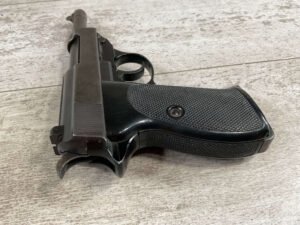
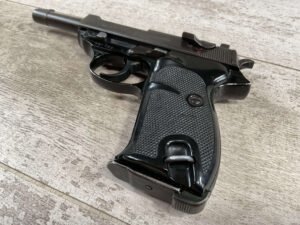
Photo source: checkpointcharlies.com
Walther P1 Postwar
Walther P1 Postwar pistol in 9x19mm Parabellum: specs, history, ammo and Colorado legal notes from the CO Boots gun library. Want hands-on time with a firearm like the Walther P1 Postwar? Our certified instructors cover safe handling, operation and marksmanship in every firearms training class.
| Library ID | GT-1600 |
|---|---|
| Manufacturer | Walther |
| Type | Pistol |
| Caliber | 9x19mm Parabellum |
| Action | Semi-automatic |
| Barrel Length | The barrel length of the Walther P1 Postwar is 4.9 inches (125 mm). |
| Country of Origin | Germany |
| Year of Production | 1963 |
| Production Status | Discontinued |
| Typical Users | Military, Law Enforcement, Civilians |
| Rating | 4.2 |
Walther P1 Postwar: Technical Specifications
The Walther P1 is a postwar variant of the P38, developed for the German military. It is chambered in 9mm Parabellum (.9x19mm) and features a barrel length of 4.9 inches (125 mm). The pistol has an overall length of 7.6 inches (193 mm) and weighs approximately 2.2 lbs (1 kg) when unloaded.
The P1 is made primarily of aluminum alloy for the frame, which reduces weight while maintaining durability, while the slide is constructed from steel. It has a double/single action mechanism and a magazine capacity of 8 rounds.
Notable engineering features include a decocking lever and a unique blowback system that enhances reliability. The P1 is recognized for its accuracy, ergonomic grip, and robust construction, making it a favored choice for military and law enforcement use in various countries. Its innovative design paved the way for modern service pistols.
Walther P1 Postwar: Performance Characteristics
The Walther P1, a postwar variant of the P38, is renowned for its accuracy and reliability. Chambered in 9x19mm, it features a double/single action mechanism, allowing for quick follow-up shots. The cold hammer-forged barrel enhances precision, typically delivering 2-3 inch groups at 25 yards, making it suitable for both target shooting and defense.
Reliability is a hallmark; the P1 operates smoothly with a robust design that withstands extensive use. Its aluminum frame reduces weight, improving handling without sacrificing durability. The ergonomics are user-friendly, with a comfortable grip that facilitates control during firing.
The P1’s rate of fire is around 15 rounds per minute in semi-automatic mode, with an 8 or 15-round magazine capacity depending on the model. The sights are fixed, but some users find them adequate for quick target acquisition. Overall, the Walther P1 is praised for its balanced performance, making it a favored choice among shooters and collectors alike.
Walther P1 Postwar: Design Features
The Walther P1 is a postwar variant of the P38, featuring a streamlined design that combines functionality with aesthetic appeal. Its ergonomic grip is crafted to fit comfortably in the hand, promoting control and accuracy. The frame is made of aluminum alloy, making it lightweight yet durable, while the barrel and slide are steel for added strength.
Safety mechanisms include a decocking lever that safely lowers the hammer, preventing accidental discharges. The P1 also features a manual safety that blocks the trigger, enhancing security. A unique aspect is its double-action/single-action (DA/SA) firing system, allowing for versatile operation.
Aesthetically, the P1 exhibits clean lines and a modern look, with a matte finish that reduces glare. It has a distinctive slide serration pattern for improved manipulation. Innovative features include a simplified blowback operation and a removable barrel, allowing for easier maintenance and versatility in use. Overall, the Walther P1 balances practicality with elegant design.
Walther P1 Postwar: Historical Context
The Walther P1, a postwar variant of the P38, emerged in the early 1950s as West Germany rearmed after WWII. Originally developed by Carl Walther in the 1930s, the P38 served as the standard issue for the Wehrmacht. Following the war, the P38 was re-engineered and designated P1, featuring aluminum alloy frames to reduce weight.
Key milestones include its adoption by the Bundeswehr in 1957, marking a significant transition to modern firearm design in Germany. The P1 was notable for its double/single-action mechanism and a unique decocking feature.
The P1 saw extensive use in NATO forces, influencing design trends in military handguns. Its reliability and accuracy made it popular among various police and military units. Notably, it was used during the Cold War era, symbolizing West Germany's reintegration into the global defense structure.
The P1's design principles have informed subsequent models, cementing its legacy in modern firearm manufacturing and establishing a benchmark for future semi-automatic pistols.
Walther P1 Postwar: User Experience
The Walther P1 Postwar is well-regarded for its ergonomic design, offering a comfortable grip that accommodates various hand sizes. Users appreciate its balanced weight distribution, making it easy to handle during extended shooting sessions. The double/single-action trigger provides versatility, though some find the initial double-action pull heavier than preferred.
Ease of use is another strong point; the P1 features a straightforward disassembly process for cleaning and maintenance, which many users find appealing. Durability is commendable, with the alloy frame and steel slide standing up well to regular use, although some report minor wear over time.
Common praises include its accuracy and reliability, with many noting it performs well with a variety of ammunition. However, complaints often center around its slightly heavier weight compared to other compact models, and a few users have experienced issues with magazine feed reliability. Overall, the P1 is appreciated for its solid construction and user-friendly characteristics.
Walther P1 Postwar: Ammunition Information
The Walther P1 is a postwar variant of the P38, chambered primarily in 9mm Parabellum (9x19mm). This caliber is widely used and compatible with various brands, including Speer, Federal, Winchester, and Hornady, among others. The P1 typically functions well with standard FMJ (Full Metal Jacket) rounds for practice and training, while JHP (Jacketed Hollow Point) ammunition is recommended for self-defense due to its expansion properties.
For optimal performance, high-quality ammunition with consistent velocity and accuracy is advised. Some shooters prefer +P (overpressure) rounds for enhanced stopping power, though it is essential to confirm the firearm's capability to handle such loads. Brands like Sig Sauer and Remington also produce reliable options. When selecting ammunition, it's crucial to test different brands and types to ensure reliable feeding and ejection in the specific P1 variant, as individual firearms may exhibit preferences for certain loads.
Walther P1 Postwar: Usage Tips and Best Practices
Walther P1 Postwar Usage Tips
Cleaning & Maintenance:
1. Field Strip: Regularly disassemble the P1 for thorough cleaning. Ensure the firearm is unloaded before disassembly.
2. Cleaning: Use a solvent to clean the barrel with a bore brush and patches. Wipe down the slide, frame, and recoil spring with a cloth. Use gun oil on moving parts and the barrel.
3. Inspection: Regularly check for wear on the recoil spring and magazine. Replace parts as necessary.
Shooting Tips:
1. Grip: Maintain a firm grip, ensuring your hands are high on the backstrap to reduce recoil.
2. Stance: Use a stable stance (isometric or Weaver) to enhance accuracy.
3. Trigger Control: Practice smooth trigger pulls to avoid jerking the gun.
Common Mistakes:
1. Neglecting Maintenance: Avoid skipping regular cleaning; it can lead to malfunctions.
2. Poor Grip: Ensure your grip is consistent; a loose grip can affect accuracy.
3. Flinching: Practice dry firing to develop a steady aim and reduce flinching.
Legal Considerations in Colorado
The Walther P1, a postwar variant of the P38, is classified as a semi-automatic pistol. Its legal status in the U.S. generally falls under federal firearm regulations, classifying it as a Title I firearm. Military use was primarily in West Germany and NATO forces, while civilian ownership is permitted, subject to state laws.
State regulations vary widely: some states require permits or registrations, while others do not. States like California and New York have more stringent laws regarding handguns, including assault weapon bans that may affect certain features of the P1.
Notable legal cases related to the P1 are scarce, but issues may arise regarding its importation and compliance with state-specific features. Always check local laws before purchasing or carrying a Walther P1, as regulations can change frequently.
Walther P1 Postwar: Reviews and Ratings
User reviews for the Walther P1 Postwar generally highlight its reliability and accuracy as standout features. Many users appreciate the firearm's sturdy construction and smooth operation, noting that it performs well in various conditions. The accuracy is frequently praised, with many users reporting tight groupings at the range.
Customer service experiences tend to be mixed; while some users report positive interactions, others cite delays or unhelpful responses. Overall satisfaction is high among those who value the P1’s historical significance and unique design, often describing it as a great collector's piece as well as a functional firearm.
Some users do mention concerns about the availability of parts and the weight of the pistol, indicating it may not be ideal for everyday carry. Nonetheless, the consensus leans towards a favorable view, with many recommending the P1 for both enthusiasts and those seeking a reliable sidearm.
Walther P1 Postwar: Appearances in Media
The Walther P1, a postwar variant of the Walther P38, has appeared in various movies, TV shows, and video games. Here’s a brief list of notable appearances:
Movies:
1. "James Bond: Die Another Day" (2002) - It was used by characters in the film, contributing to the spy theme.
2. "The Man from U.N.C.L.E." (2015) - Featured as part of the film's Cold War espionage setting.
TV Shows:
1. "The Americans" (2013-2018) - This series set during the Cold War features the Walther P1 among other firearms.
2. "Hannibal" (2013-2015) - The Walther P1 appears as a weapon used by various characters.
Video Games:
1. "Counter-Strike: Global Offensive" (2012) - The Walther P1 is available as a weapon in the game.
2. "Battlefield V" (2018) - The firearm is included in the game's World War II setting.
These examples highlight the Walther P1's representation in various media, particularly in contexts involving espionage or military themes.
Related Firearms in the Library


More Pistol firearmsMore Walther manufacturer firearmsMore 9mm Luger caliber firearmsMore Germany country firearmsBrowse all firearms