


Photo source: upload.wikimedia.org, gunsmagazine.com
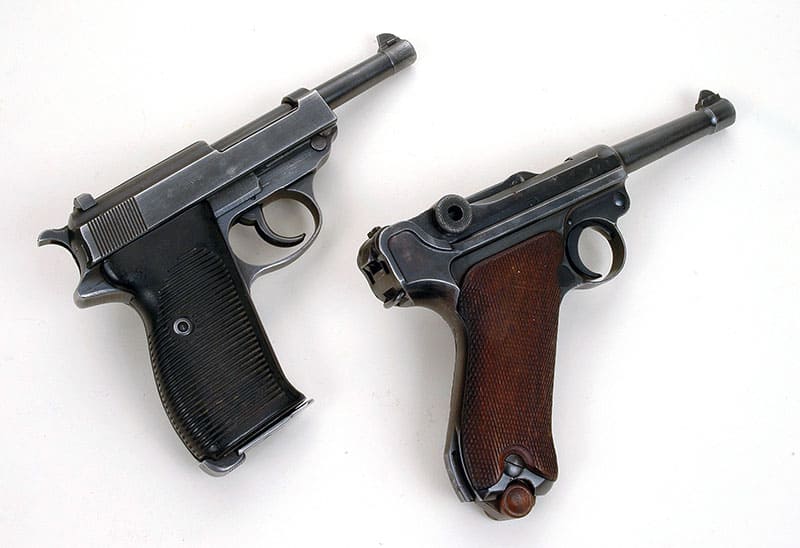
P38 9mm
P38 9mm pistol in 9x19mm: specs, history, ammo and Colorado legal notes from the CO Boots gun library. Want hands-on time with a firearm like the P38 9mm? Our certified instructors cover safe handling, operation and marksmanship in every firearms training class.
| Library ID | GT-456 |
|---|---|
| Manufacturer | Walther |
| Type | Pistol |
| Caliber | 9x19mm |
| Action | Semi-automatic |
| Barrel Length | The barrel length of the P38 9mm is 4.9 inches (125 mm). |
| Country of Origin | Germany |
| Year of Production | 1938 |
| Production Status | Discontinued |
| Typical Users | Military, Law Enforcement, Civilians |
| Rating | 4.2 |
P38 9mm: Technical Specifications
The P38 is a semi-automatic pistol developed by Walther, primarily used by the German military during World War II. Its technical specifications include:
- Caliber: 9x19mm Parabellum
- Barrel Length: Approximately 4.9 inches (124 mm)
- Weight: Around 2.2 lbs (1,000 g) when unloaded
- Material: Typically features a steel frame with an aluminum alloy frame for weight reduction, and a blued or phosphate finish for corrosion resistance.
Key Features:
- Action: Double/single action with a decocking mechanism.
- Magazine Capacity: Standard 8-round detachable box magazine.
- Sights: Fixed front and rear sights, often adjustable on later models.
- Unique Engineering: The P38 introduced a locking system using a tilting barrel and a unique design for the firing mechanism, enhancing reliability and accuracy. It was one of the first service pistols to incorporate a double-action trigger.
The P38's design influenced many subsequent handguns and remains a significant historical firearm.
P38 9mm: Performance Characteristics
The P38 9mm, developed by Walther during World War II, is notable for its distinctive design and performance characteristics.
Accuracy: The P38 features a 4.9-inch barrel and is known for its good accuracy, particularly at combat ranges. The fixed front and rear sights facilitate quick target acquisition, making it effective for both precision and rapid-fire scenarios.
Reliability: The P38 is generally reliable, though some models may experience issues with ammunition types or magazine feed. Its double/single action mechanism provides a smooth trigger pull, enhancing shot control.
Handling: Weighing around 2.2 lbs, the P38 has a balanced feel that aids in handling. The ergonomic grip design allows for comfortable extended use, and the safety decocker adds to its user-friendly operation.
Rate of Fire: As a semi-automatic pistol, the P38 can achieve a practical rate of fire, with skilled shooters capable of firing multiple rounds rapidly.
Overall, the P38 is respected for its solid performance, combining historical significance with functional reliability.
P38 9mm: Design Features
The P38 9mm, designed by Walther in the 1930s, features a distinctive double-action/single-action (DA/SA) mechanism, allowing for a first shot in double action and subsequent shots in single action. Its ergonomic design includes a comfortable grip, a low bore axis, and a well-angled frame, enhancing stability and control during firing. The gun incorporates a manual safety, which also functions as a decocker, allowing the hammer to drop safely.
Aesthetically, the P38 boasts a classic, military-inspired look with smooth lines and a robust metal finish. Its innovative features include a unique locking system with a tilting barrel and a relatively low weight due to its aluminum frame, making it easy to handle. The P38 was one of the first to use a fixed barrel and a recoil-operated system, setting a precedent for future service pistols. Additionally, its magazine release is positioned conveniently for quick reloading, reflecting practicality in design.
P38 9mm: Historical Context
The P38 9mm, developed by Walther in the late 1930s, was designed as a replacement for the P08 Luger. Its development was driven by the German military's need for a reliable, semi-automatic pistol with a double-action mechanism. Officially adopted by the Wehrmacht in 1938, the P38 featured a unique locking mechanism and was one of the first to incorporate a double-action trigger.
Key milestones include its introduction in World War II, where it became standard issue for German soldiers. The P38 was notable for its robust design and accuracy, leading to its use by various armed forces post-war, including NATO countries.
The P38's design influenced future handgun development, notably the adoption of similar features in later models like the Beretta 92 and Sig Sauer P226. Its production continued until the early 2000s, reflecting its enduring legacy in both military and civilian markets. The P38 remains a significant piece of firearm history, symbolizing innovation in military sidearms.
P38 9mm: User Experience
The P38 9mm is generally well-regarded for its ergonomic design and comfortable grip, which accommodates a variety of hand sizes. Users appreciate its balanced weight, making it manageable for extended shooting sessions. The double/single action mechanism allows for ease of use, appealing to both novice and experienced shooters.
Durability is another strong point; the P38 is known for its robust construction, often lasting through extensive use without significant wear. Many users praise its reliability, with minimal malfunctions reported when properly maintained.
Common complaints include the weight, which some find slightly cumbersome compared to modern polymer-framed firearms. Additionally, the magazine release can be awkward for some shooters, and the slide can be stiff for those with smaller hands. Despite these issues, the P38 remains a popular choice for its historical significance and solid performance in various shooting scenarios.
P38 9mm: Ammunition Information
The P38 is a semi-automatic pistol chambered primarily in 9mm Parabellum (9x19mm), a widely used caliber known for its balance of performance and recoil. It typically utilizes standard 9mm ammunition, including Full Metal Jacket (FMJ) for target shooting and training, and Hollow Point (HP) for self-defense due to expanded terminal ballistics.
Compatibility with various brands is robust; the P38 can reliably fire ammunition from manufacturers like Federal, Speer, Winchester, and more. It’s essential to choose high-quality ammunition to ensure reliability and performance.
For optimal performance, many users recommend using ammunition specifically designed for semi-automatic pistols, which often have consistent powder loads for reliable cycling. Additionally, some shooters opt for +P (overpressure) ammunition for enhanced velocity and stopping power, though caution is advised due to potential increased wear on the firearm. Always consult the manufacturer’s guidelines before using non-standard ammunition types.
P38 9mm: Usage Tips and Best Practices
P38 9mm Usage Tips and Best Practices
Cleaning & Maintenance:
1. Disassembly: Ensure the firearm is unloaded. Follow the manufacturer’s instructions for disassembly; typically, remove the slide, barrel, and recoil spring.
2. Cleaning: Use a bore brush and patch with solvent for the barrel. Clean the slide and frame with a cloth and brush to remove residues.
3. Lubrication: Apply a light coat of gun oil on moving parts, especially the slide rails and barrel.
4. Storage: Store in a cool, dry place. Use a gun safe to prevent unauthorized access.
Shooting Tips:
1. Grip: Maintain a firm grip; use both hands for stability.
2. Stance: Adopt a proper shooting stance (isosceles or Weaver) for balance.
3. Sight Alignment: Ensure front and rear sights are aligned before shooting.
4. Trigger Control: Squeeze the trigger steadily to avoid jerking.
Common Mistakes to Avoid:
1. Neglecting Cleaning: Failing to clean regularly can lead to malfunctions.
2. Over-lubrication: Excess oil can attract dirt and debris.
3. Ignoring Safety: Always treat the firearm as if it’s loaded; keep the muz
Legal Considerations in Colorado
The P38 9mm, developed in the 1930s, is a semi-automatic pistol originally used by the German military in World War II. Its legal status varies widely between countries and within the United States, where it is classified as a firearm.
In the U.S., the P38 is legal for civilian ownership in most states, subject to federal regulations. However, individual states impose restrictions, including permits, background checks, and bans on certain models. States like California and New York have stricter regulations, often requiring microstamping and adherence to specific safety features.
Notable legal cases involving the P38 include issues of importation and the legality of possession under state-specific laws. For instance, in some jurisdictions, the P38 may be considered a "military-style" firearm, attracting more stringent regulations. It’s essential for potential owners to check local laws before purchase or carry.
P38 9mm: Reviews and Ratings
User reviews for the P38 9mm frequently highlight its reliability and accuracy, with many users praising its consistent performance in various conditions. Reviewers often describe the firearm as well-balanced and easy to handle, making it suitable for both new and experienced shooters.
However, some feedback points to issues with the magazine release and occasional jams, which can affect overall reliability. Customer service experiences vary, with some users reporting prompt and helpful responses, while others express frustration with delays or unresolved issues.
Overall satisfaction is generally high, with many users appreciating the P38's historical significance and robust construction. While a few concerns exist regarding specific mechanical issues, the majority of reviewers feel positively about the P38's performance and value for the price.
P38 9mm: Appearances in Media
The P38 9mm pistol has appeared in various movies, TV shows, and video games. Here’s a brief list:
Movies:
1. "The Man from U.N.C.L.E." (2015) - The P38 is used by characters in this spy film.
2. "Inglourious Basterds" (2009) - Several characters, including Nazi officers, are seen using the P38.
3. "Die Hard" (1988) - The P38 is one of the weapons used by the antagonists.
4. "The Bridge on the River Kwai" (1957) - Featured during scenes involving Japanese officers.
5. "The Bourne Identity" (2002) - The P38 appears as part of the character's armory.
TV Shows:
1. "Hogan's Heroes" - Often used by German soldiers in the series.
2. "Combat!" - Frequently seen in the hands of soldiers during WWII-themed episodes.
3. "The Man in the High Castle" - The P38 is depicted in the alternate history setting.
Video Games:
1. "Wolfenstein: The New Order" - The P38 appears as a weapon option for players.
2. "Call of Duty: World at War" - Featured as a sidearm in the game.
3. "Battlefield V" - The P38 is included among the weapons available to players.
These appearances showcase the P38's historical significance and its association with military and espionage themes across various media.
Related Firearms in the Library



More Pistol firearmsMore Walther manufacturer firearmsMore 9mm Luger caliber firearmsMore Germany country firearmsBrowse all firearms