
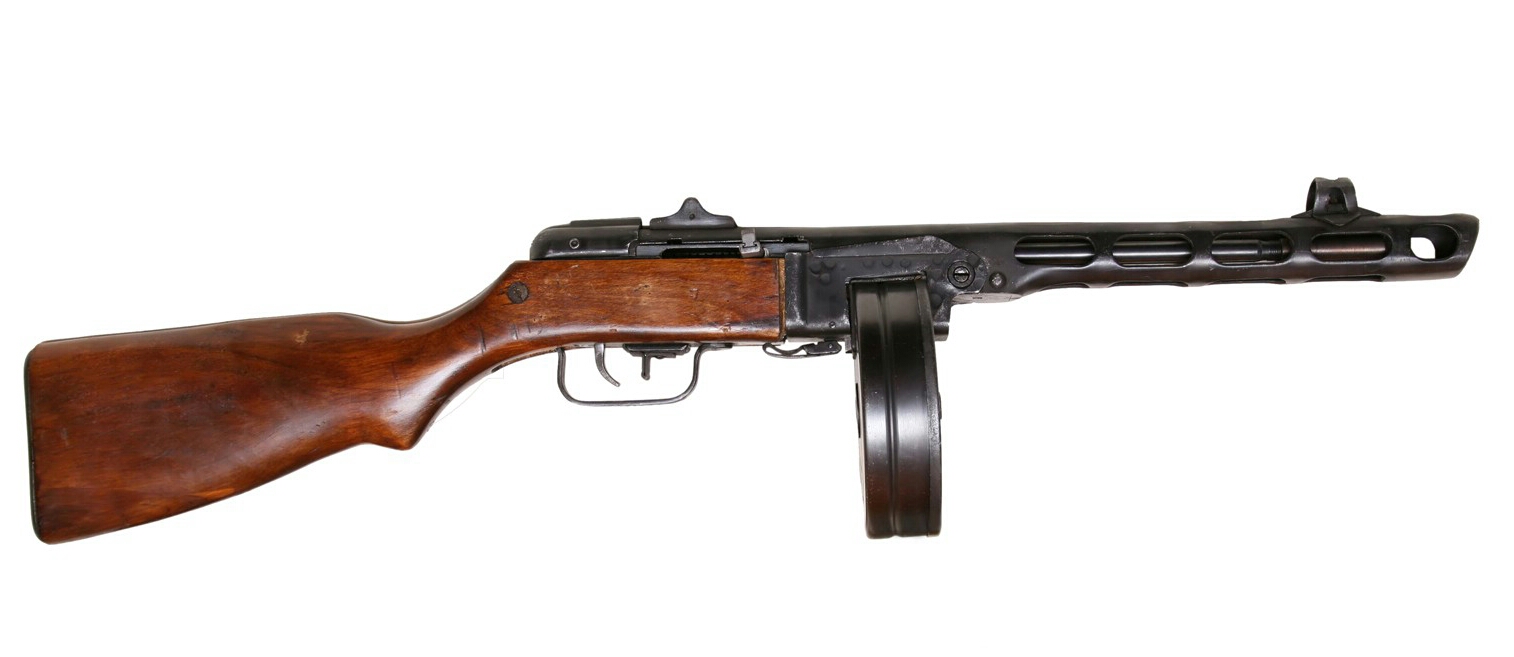


Photo source: upload.wikimedia.org, collections.rmg.co.uk, denix.es
PPSh-41
PPSh-41 submachine gun in 7.62×25mm Tokarev: specs, history, ammo and Colorado legal notes from the CO Boots gun library. Want hands-on time with a firearm like the PPSh-41? Our certified instructors cover safe handling, operation and marksmanship in every firearms training class.
| Library ID | GT-662 |
|---|---|
| Manufacturer | The Soviet Union |
| Type | Submachine Gun |
| Caliber | 7.62×25mm Tokarev |
| Action | Submachine gun |
| Barrel Length | 269 mm |
| Country of Origin | Soviet Union |
| Year of Production | 1941 |
| Production Status | Discontinued |
| Typical Users | Military, Law Enforcement |
| Rating | 4.5 |
PPSh-41: Technical Specifications
The PPSh-41 (Pistolet-Pulemyot Shpagina model 1941) is a Soviet submachine gun renowned for its reliability and high rate of fire.
Caliber: 7.62×25mm Tokarev.
Barrel Length: Approximately 263 mm (10.4 inches).
Weight: Around 3.6 kg (7.9 lbs) unloaded.
Material: Primarily constructed from steel with wooden elements for the stock and grip.
Key Features:
- Action: Blowback-operated, open bolt design.
- Rate of Fire: Approximately 900 rounds per minute.
- Magazine Capacity: Typically uses a 35-round curved magazine (with a 71-round drum available).
- Sights: Iron sights with a rear notch and a front blade.
- Unique Engineering: The PPSh-41 features a distinctive drum magazine design, allowing for higher ammunition capacity without sacrificing size. Its simple mechanism contributes to its reliability in harsh conditions, making it a favored weapon in World War II. The gun's effective range is about 200 meters.
Overall, the PPSh-41 is celebrated for its durability, ease of use, and effective suppression of enemy forces.
PPSh-41: Performance Characteristics
The PPSh-41 is a Soviet submachine gun renowned for its robust performance characteristics. It features a 7.62x25mm Tokarev cartridge, offering high velocity and effective range up to 200 meters.
Accuracy: The PPSh-41 is reasonably accurate for a submachine gun, with a typical effective range of around 150 meters. Its simple open sights allow for quick aiming in close engagements.
Reliability: Known for its ruggedness, the PPSh-41 operates effectively in harsh conditions, with a blowback mechanism that minimizes jams. Its design allows for easy maintenance.
Handling: Weighing approximately 3.6 kg (8 lbs) fully loaded, it balances well for hip firing but can be unwieldy in tight spaces. The wooden stock provides comfort, and the large drum magazine (71 rounds) contributes to its effectiveness but adds weight.
Rate of Fire: The PPSh-41 boasts a high rate of fire, around 900 rounds per minute, making it formidable in close-quarter combat.
Overall, the PPSh-41 is celebrated for its durability, firepower, and effectiveness in various combat scenarios.
PPSh-41: Design Features
The PPSh-41, developed during World War II, is a submachine gun known for its distinctive design and functionality.
Ergonomics: It features a wooden stock and a pistol grip that provide a comfortable hold, allowing for rapid firing and maneuverability. The gun's overall balance is conducive to sustained fire, making it user-friendly in combat situations.
Safety Mechanisms: The PPSh-41 includes a simple but effective safety mechanism, typically a lever located on the right side of the receiver. When engaged, it blocks the trigger, preventing accidental discharges.
Aesthetic Design: The PPSh-41 has a utilitarian aesthetic, characterized by its robust metal construction and wooden components. The round drum magazine, holding up to 71 rounds, gives it a distinctive silhouette.
Innovative Features: Its blowback operation system simplifies design and maintenance. The high rate of fire, combined with its reliability in harsh conditions, and the ability to use a large-capacity magazine, made the PPSh-41 a revolutionary weapon in its time.
PPSh-41: Historical Context
The PPSh-41, or "Pistolet-Pulemyot Shpagina," was developed in the Soviet Union during the late 1930s by designer Georgy Shpagin. It emerged from the need for a reliable submachine gun to equip Soviet infantry, particularly during the Second World War. The PPSh-41 was officially adopted in 1940 and became iconic for its high rate of fire, robust construction, and use of the 7.62x25mm Tokarev cartridge.
Key milestones include its mass production during WWII, with over 6 million units made, and its widespread use in major battles like Stalingrad and Kursk. The PPSh-41's effectiveness in close-quarters combat and urban warfare established it as a staple of Soviet troops.
Post-war, it influenced submachine gun designs globally, showcasing the utility of drum magazines and blowback operation. Its legacy continued in various conflicts, remaining in service in various countries long after the war, shaping the evolution of automatic firearms.
PPSh-41: User Experience
The PPSh-41 is often praised for its robust design and reliability, making it a favorite among users. Comfort-wise, the weapon's wooden stock provides a warm feel, while the submachine gun's weight helps mitigate recoil, allowing for manageable firing control. Its rate of fire and 71-round drum magazine enhance its ease of use in close-quarters combat, though some find the weight cumbersome during prolonged use.
Durability is a standout feature; the PPSh-41 was engineered to withstand harsh conditions, making it a resilient choice for users in various environments. However, common complaints include the complexity of reloading the drum magazine, which can be time-consuming, and the weapon's length, which may hinder maneuverability in tight spaces. Overall, users appreciate its historical significance and effectiveness, yet some express a desire for lighter alternatives or improved magazine designs for modern use.
PPSh-41: Ammunition Information
The PPSh-41, a Soviet submachine gun, primarily uses the 7.62x25mm Tokarev cartridge. This round, originally designed for the Tokarev TT-33 pistol, is renowned for its high velocity (around 450 m/s) and flat trajectory, making it effective in close-quarter combat.
While the PPSh-41 is specifically designed for the 7.62x25mm caliber, various manufacturers produce this ammunition, including brands like Sellier & Bellot, Prvi Partizan, and Wolf Performance Ammunition. Compatibility is generally high across these brands, ensuring reliable function.
For optimal performance, it’s recommended to use high-quality, non-corrosive ammunition to reduce fouling and ensure smooth operation. Subsonic rounds are available for quieter shooting, though they may affect the weapon's cycling. The PPSh-41 can also utilize drum magazines, which enhance its sustained fire capability, making it crucial to choose ammunition that feeds reliably in these configurations.
PPSh-41: Usage Tips and Best Practices
PPSh-41 Usage Tips:
- Cleaning and Maintenance:
- Disassembly: Regularly disassemble the weapon for thorough cleaning. Remove the bolt, recoil spring, and barrel.
- Cleaning: Use a bore brush and cleaning rod to clean the barrel. Wipe down the bolt and receiver with a solvent to remove carbon buildup.
- Lubrication: Apply a light coat of gun oil on moving parts to prevent rust and ensure smooth operation. Avoid over-lubrication, which can attract dirt.
- Inspect: Check for wear on the recoil spring and firing pin. Replace parts as needed.
- Shooting Tips:
- Stance: Use a stable shooting stance with a firm grip to absorb recoil.
- Aiming: Use the iron sights effectively, focusing on target acquisition.
- Rate of Fire: Fire in controlled bursts to maintain accuracy, especially in full-auto mode.
- Common Mistakes:
- Neglecting Cleaning: Failing to clean regularly can lead to malfunctions.
- Overloading Magazines: Avoid overfilling magazines to ensure smooth feeding.
- Ignoring Safety: Always treat the firearm as if it’s loaded and follow all sa
Legal Considerations in Colorado
The PPSh-41, a Soviet submachine gun, is classified as a Title II firearm under the National Firearms Act (NFA) in the U.S. Due to its automatic firing capability, it is heavily regulated. Civilian ownership is allowed only with a federal tax stamp and registration with the Bureau of Alcohol, Tobacco, Firearms and Explosives (ATF). Military use is generally unrestricted by federal law for armed forces.
State-by-state regulations vary significantly. Some states, like California and New York, prohibit or impose strict regulations on ownership of fully automatic firearms, while others may allow them under NFA compliance. Notable legal cases involving the PPSh-41 are rare, but challenges often arise around the legality of conversions and modifications to semi-automatic variants. Always check local laws before acquiring such firearms, as regulations can change frequently.
PPSh-41: Reviews and Ratings
User reviews for the PPSh-41 generally highlight its reliability and durability, with many praising its robust construction that withstands harsh conditions. Reviewers often note that it performs consistently well in various environments, making it a favored choice among historical firearm enthusiasts and collectors.
Accuracy receives mixed feedback; while some users find it adequate for its intended use, others feel it could be improved, particularly at longer ranges. The magazine capacity is frequently lauded, with many appreciating the ability to fire in rapid succession without frequent reloads.
Customer service experiences are mostly positive, with users reporting prompt responses and helpful assistance when issues arise. Overall satisfaction tends to be high, especially among those who value historical significance and functionality over modern precision. The PPSh-41 is often described as a fun and iconic firearm, ideal for collectors and recreational shooters alike.
PPSh-41: Appearances in Media
The PPSh-41, a Soviet submachine gun, has appeared in various movies, TV shows, and video games. Here’s a brief list of some notable appearances:
Movies:
1. Enemy at the Gates (2001) - The PPSh-41 is featured prominently in the depiction of World War II battles.
2. The Pianist (2002) - The firearm is used during scenes set in wartime Warsaw.
3. Come and See (1985) - A powerful portrayal of World War II in Belarus, featuring the PPSh-41.
4. The Bridge on the River Kwai (1957) - Features the PPSh-41 in various scenes of conflict.
TV Shows:
1. Band of Brothers (2001) - The series includes scenes of soldiers using various firearms, including the PPSh-41.
2. Generation Kill (2008) - The series depicts modern warfare with some references to historical firearms, including the PPSh-41.
Video Games:
1. Call of Duty Series - The PPSh-41 appears in multiple titles, especially in those set during World War II, such as "Call of Duty: World at War".
2. Battlefield Series - Various games in the franchise, particularly those focusing on World War II, feature the PPSh-41.
3. Day of Infamy - A World War II shooter that includes the PPSh-41 as a playable weapon.
4. Red Orchestra 2: Heroes of Stalingrad - This game includes the PPSh-41 in its historically accurate arsenal.
This list is not exhaustive, as the PPSh-41 has made appearances in various other media, but these are some of the most notable.
Related Firearms in the Library


More Submachine Gun firearmsMore Soviet Union country firearmsBrowse all firearms