
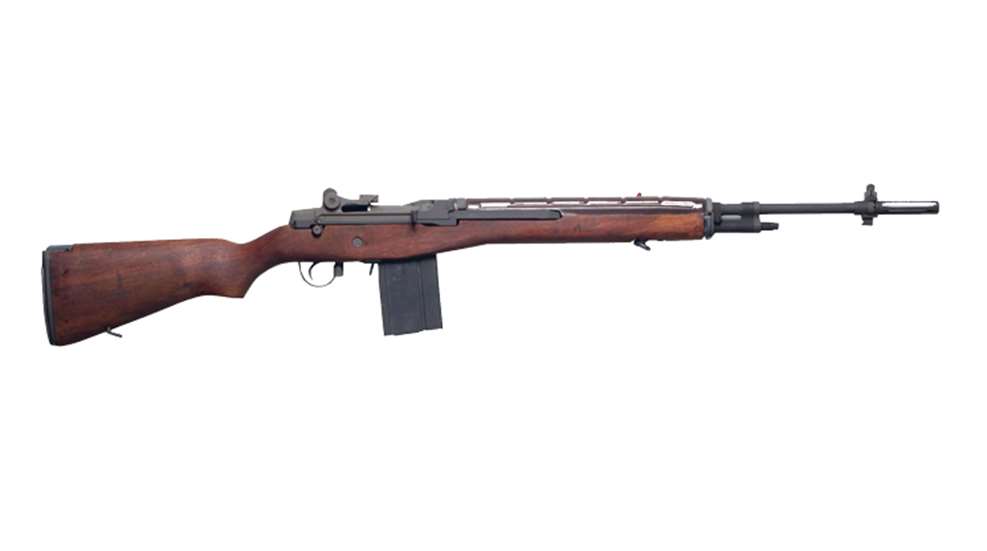


Photo source: americanrifleman.org, grayssportingjournal.com, static.wikia.nocookie.net
M14
M14 rifle in 7.62×51mm NATO: specs, history, ammo and Colorado legal notes from the CO Boots gun library. Want hands-on time with a firearm like the M14? Our certified instructors cover safe handling, operation and marksmanship in every firearms training class.
| Library ID | GT-351 |
|---|---|
| Manufacturer | Springfield Armory |
| Type | Rifle |
| Caliber | 7.62×51mm NATO |
| Action | Semi-automatic |
| Barrel Length | 22 inches (559 mm) |
| Country of Origin | United Kingdom |
| Year of Production | 1959 |
| Production Status | In limited production |
| Typical Users | Military, Law Enforcement, Civilians |
| Rating | 4.5 |
M14: Technical Specifications
The M14 is a selective-fire battle rifle developed in the United States in the late 1950s. Key specifications include:
- Caliber: 7.62x51mm NATO (.308 Winchester).
- Barrel Length: Typically 22 inches (559 mm).
- Weight: Approximately 9.2 lbs (4.18 kg) unloaded.
- Material: The receiver is made from forged steel, while the stock is traditionally wood, with some variants using synthetic materials.
Key Features:
- Operating System: Gas-operated, rotating bolt mechanism.
- Fire Modes: Semi-automatic and selective fire (full-auto versions exist).
- Magazine Capacity: Standard 20-round detachable magazine.
- Sights: Equipped with adjustable iron sights, with some variants having scope mounts.
Unique Aspects: The M14 features a unique combination of traditional rifle design with modern elements, including a flash suppressor and a barrel that can accommodate a bayonet. Its design allows for effective accuracy and range, making it versatile in various combat scenarios.
M14: Performance Characteristics
The M14 rifle, chambered in 7.62×51mm NATO, is renowned for its accuracy and reliability. It features a traditional wooden stock and a gas-operated, rotating bolt mechanism, providing consistent performance.
Accuracy: The M14 is known for its impressive accuracy, capable of 1.5 to 2 MOA under ideal conditions, making it effective for both close and long-range engagements.
Reliability: Its robust design ensures dependable operation in various environments, though it can be sensitive to dirt and requires regular maintenance.
Handling: Weighing around 9.2 lbs, it balances well, but its weight can be cumbersome during prolonged use. The M14's adjustable sights enhance aiming precision.
Rate of Fire: The semi-automatic operation allows for a cyclic rate of fire of about 750-800 rounds per minute in automatic variants, with a practical sustained rate of around 40-60 RPM.
Overall, the M14 combines effective range, solid build, and versatility, though it requires skilled handling to fully utilize its capabilities.
M14: Design Features
The M14 rifle features a classic design characterized by its robust wooden stock and metal components, giving it a solid and traditional aesthetic. Ergonomically, it has a straight stock with a slight pistol grip, promoting a comfortable hold and aiming stability. The adjustable rear sight and front post enhance accuracy, while the rifle's weight (approximately 10.5 lbs) aids in recoil management.
Safety mechanisms include a manual safety located at the rear of the trigger guard, preventing accidental discharge. The M14 can operate in both semi-automatic and automatic modes, offering versatility in firepower.
Innovatively, the M14 utilizes a gas-operated, rotating bolt system, enhancing reliability and precision. Its detachable magazine holds 20 rounds of .308 Winchester/7.62 NATO ammunition, allowing for quick reloads. The rifle's combination of wood and metal gives it a classic military appearance, while its performance features have cemented its legacy in firearms history.
M14: Historical Context
The M14 rifle was developed in the United States during the late 1940s and early 1950s as a successor to the M1 Garand. Designed by Eugene Stoner, it incorporated a select-fire mechanism, allowing for both semi-automatic and automatic fire, and used the 7.62x51mm NATO cartridge. The M14 was officially adopted by the U.S. Army in 1957.
Key milestones include its deployment during the Vietnam War, where it faced challenges due to its weight and length compared to newer designs. Despite being phased out in favor of the M16, the M14 saw continued use among specialized units and in various conflicts, including in Iraq and Afghanistan.
The M14's design influenced future rifles, emphasizing modularity and reliability. Its legacy persists in modern firearm concepts, and it remains popular among collectors and civilian shooters. The M14's blend of traditional and modern features showcases the evolution of military firearms post-World War II.
M14: User Experience
The M14 rifle is often praised for its robust construction and historical significance, being a reliable service weapon from the 1950s onward. Users appreciate its comfortable, ergonomic design, particularly the traditional wood stock, which many find aesthetically pleasing and easy to handle. The rifle's weight can be a point of contention, as some users feel it is heavier than modern alternatives, impacting maneuverability during extended use.
In terms of ease of use, the M14's semi-automatic function is generally regarded as intuitive, though its sights may require adjustment for optimal accuracy. Users often commend its durability, noting that it can withstand harsh conditions and maintain performance over time.
Common complaints include the rifle's recoil, which some find significant, and the limited magazine capacity compared to modern designs. Additionally, some users report difficulty in finding aftermarket parts. Overall, the M14 garners respect for its reliability and classic design, with a dedicated following among enthusiasts and collectors.
M14: Ammunition Information
The M14 rifle primarily uses the 7.62x51mm NATO caliber, also known as .308 Winchester. This versatile cartridge is renowned for its accuracy and stopping power. The M14 can also chamber .308 Winchester, making it compatible with a wide range of ammunition brands, including Lake City, Federal, Hornady, and Winchester.
For optimal performance, especially in precision shooting, match-grade ammunition like Federal Gold Medal or Hornady Match is recommended due to their superior consistency and accuracy. Additionally, the M14 can fire various specialized ammunition types, such as tracer rounds, armor-piercing (M61), and hollow-point boat tail (HPBT) rounds for specific applications.
It’s important to ensure that ammunition matches the rifle’s specifications to avoid reliability issues. The M14 is known for its robustness, and with the right ammunition, it excels in both military and competitive shooting contexts.
M14: Usage Tips and Best Practices
M14 Usage Tips and Best Practices:
- Cleaning and Maintenance:
- Clean the barrel and action after every use. Use a bore brush and solvent to remove fouling.
- Oil the action with a light gun oil to prevent rust, but avoid over-lubrication.
- Inspect the gas system regularly; ensure the gas piston is clean and free of carbon buildup.
- Store in a cool, dry place, preferably in a protective case.
- Shooting Tips:
- Practice proper stance and grip to manage recoil; the M14 has significant kick.
- Use a sling for stability, especially in prone position.
- Adjust the rear sight for different distances; familiarize yourself with the sight picture.
- Common Mistakes to Avoid:
- Avoid using excessive force when cycling the action; it can cause malfunctions.
- Don’t neglect the gas system; a dirty system can lead to failure to cycle.
- Always ensure the rifle is clear before cleaning or handling.
Following these tips will enhance performance and longevity of the M14.
Legal Considerations in Colorado
The M14 rifle, a military firearm developed in the 1950s, is legally classified as a semi-automatic rifle for civilian use. In the U.S., the M14 is generally legal for civilian ownership, but it is subject to various state regulations. Some states, like California and New York, have restrictions on semi-automatic rifles, which may include bans on features like high-capacity magazines or pistol grips.
Federal law requires M14 rifles to be registered and transfer records maintained when sold through licensed dealers. Notably, the M14's military variants, such as fully automatic versions, are classified as Title II firearms and are heavily regulated under the National Firearms Act.
Legal cases involving the M14 often center around challenges to state laws regulating assault weapons. For instance, in Parker v. District of Columbia (2007), the court addressed Second Amendment rights, indirectly influencing discussions about military-style firearms like the M14. Compliance with local laws is crucial for owners.
M14: Reviews and Ratings
User reviews for the M14 rifle consistently highlight several key themes.
Reliability: Many reviewers praise the M14 for its robust design and reliability, particularly in harsh conditions. Users often mention that it performs well with minimal jams, reinforcing its reputation as a dependable firearm.
Accuracy: The M14 is frequently noted for its impressive accuracy, with users reporting tight groupings at various ranges. Many shooters appreciate its inherent precision, making it a favorite for both competitive shooting and hunting.
Customer Service: Experiences with customer service vary. Some users report positive interactions with manufacturers, noting prompt responses and good support, while others express frustration with delays or unhelpful service.
Overall Satisfaction: Overall, satisfaction is high among M14 owners, who often describe it as a classic and effective rifle. Despite its weight and recoil, many find the performance and heritage of the M14 worth any drawbacks.
M14: Appearances in Media
The M14 rifle has appeared in various movies, TV shows, and video games. Here’s a brief list:
Movies:
1. Full Metal Jacket (1987) - The M14 is prominently featured during the boot camp scenes.
2. Black Hawk Down (2001) - Soldiers are seen using the M14 during the battle in Mogadishu.
3. American Sniper (2014) - The M14 is depicted as a sniper rifle in some scenes.
TV Shows:
1. The A-Team (1983-1987) - The M14 is used by the characters in various episodes.
2. Band of Brothers (2001) - Featured among the weapons used by American soldiers during World War II.
3. The Pacific (2010) - Similar to Band of Brothers, it showcases the M14 in the context of World War II.
Video Games:
1. Call of Duty series - The M14 appears in several titles, including "Call of Duty: Modern Warfare" and "Call of Duty: Black Ops."
2. Battlefield series - The M14 is featured in games like "Battlefield: Bad Company 2" and "Battlefield 3."
3. Far Cry 2 (2008) - The M14 is one of the weapons players can use.
This list is not exhaustive, but it highlights some notable appearances of the M14 in popular media.
Related Firearms in the Library



More Rifle firearmsMore Springfield Armory manufacturer firearmsMore 7.62×51mm NATO caliber firearmsMore United Kingdom country firearmsBrowse all firearms